有很多理由值得讓我們考慮從飲食中去除雞蛋。研究顯示攝取雞蛋與心臟病、糖尿病甚至癌症有關1,2。
雞蛋超過 60% 的熱量來自脂肪,而且大部分是飽和脂肪。
一般大小的雞蛋就含有 186 毫克的膽固醇3。舉凡有高膽固醇、糖尿病或心血管疾病的人,都建議膽固醇攝取要控制在200 毫克以下2,4。但飲食攝取任何膽固醇都是無必要的,因為我們的身體會自行製造多於我們所需的膽固醇。蛋還缺乏纖維,而纖維是長期健康最重要的營養素之一。
心臟病
膽固醇和飽和脂肪促進了雞蛋攝取和心臟病之間的關聯。幾十年的研究表明,食用高膽固醇食物(如雞蛋)與血膽固醇水平升高和心臟病有關,儘管提倡低碳水化合物、高脂飲食的人可能會提出爭議5-8。當您觀察在已經食用高膽固醇飲食的人的飲食中添加高膽固醇食物的影響時,就會產生困惑。
這對他們血膽固醇水平的影響微乎其微。這些人患心臟病的風險已經很高,多吃雞蛋對風險的影響微乎其微。
儘管有研究表明,吃雞蛋不會對膽固醇水平產生負面影響,但一篇發表在《美國生活醫學雜誌 (American Journal of Lifestyle Medicine)》的綜述發現,無論研究經費來源為何,超過 85% 的研究都顯示雞蛋對血膽固醇有不利影響。產業資助的研究更有可能淡化這些發現9。然而,在食用低膽固醇飲食時,膽固醇攝取量增加、血膽固醇水平升高和心臟病風險增加之間存在明確的反應10。當血膽固醇水平較高時,血管壁更容易增厚並限制血液流向心臟和腦部等器官。
研究還表明,雞蛋中的一種必需營養素膽鹼的副產物會增加心臟病發作或中風的風險11。當一個人吃雞蛋時,腸道細菌會分解膽鹼,在血液中釋放一種叫做氧化三甲胺酶 (TMAO)的有毒化合物。
所有這些因素都會導致心血管問題。一項結合 14 項研究結果的綜述發現,經常吃雞蛋的人患心臟病和中風的風險增加。即使每天吃一顆雞蛋也會顯著增加死於心臟病的風險12-14。對於已經患有糖尿病的人,經常吃雞蛋患心臟病的風險甚至更高1。另一項研究發現,每週吃 7 顆以上雞蛋的人冠狀動脈鈣評分(衡量心臟病風險的指標)高出 80%。這種聯繫在吃蔬菜少而體重高的人身上表現得最明顯15。
高膽固醇也與健康問題有關,如乳癌、關節疼痛和發炎以及不孕6-19。最後,從食物中攝取膽固醇而不攝取與之相伴隨的飽和脂肪是不可能的。過量的飽和脂肪會增加膽固醇水平,長期來看,會使人面臨更高的不良健康結局風險20,21
糖尿病
膽固醇和飽和脂肪水平較高與雞蛋攝取和糖尿病風險密切相關。高脂飲食會導致胰島素阻抗,因為脂肪會干擾胰島素將葡萄糖從血液帶入細胞的能力22。研究表明,每週攝取三顆或以上雞蛋的人患糖尿病的風險會增加,而且風險會隨著雞蛋攝取量的增加而增加1,23。
根據一項在《營養、代謝與心血管疾病 (Nutrition, Metabolism, & Cardiovascular Diseases)》中發表的統合分析,發現每天增加 100 毫克膽固醇(一顆雞蛋約含 186 毫克),罹患第2型糖尿病的風險就會增加 5%24。在納入 21,000 多例受試者的醫師健康研究 I 中,研究人員發現,每週攝取 7 顆或更多雞蛋的人,死亡風險比攝取較少雞蛋的人高 25% 左右。對於糖尿病受試者,死亡風險是雞蛋攝取量最少的人的兩倍25。
根據《美國流行病學雜誌 (American Journal of Epidemiology)》中所提及的兩項研究,雞蛋攝取還會增加妊娠糖尿病的風險。在一項研究中,與攝取雞蛋最少(每周少於一顆)的女性相比,攝取雞蛋最多(每週超過七顆)的女性患有糖尿病的風險增加了 77%,在另一項研究中增加了 165%26。
癌症
食用雞蛋可能會增加某些癌症的風險,如結腸癌、直腸癌、膀胱癌、攝護腺癌和乳腺癌22,23。研究表明,食用雞蛋產生的 TMAO 會促進癌症的生長,特別是增加乳癌、卵巢癌和攝護腺癌的風險27-29。
食用雞蛋也使消化道特別容易罹患癌症。不幸的是,即使是食用少量雞蛋也存在風險——每週攝取 1.5 顆雞蛋的人,患有結腸癌的風險和每年攝取少於 11 顆雞蛋的人相比,機率接近 5 倍30。最近 37 項研究的綜述證實了這些發現——一個人吃的雞蛋越多,患消化道癌症的風險就越高28。吃雞蛋不僅會增加罹患癌症的風險,還會增加死於結腸癌和直腸癌的風險31。同樣,即使是適度的雞蛋攝取也會使罹患膀胱癌的風險增加三倍32。
一項 2011 年哈佛大學由美國國立衛生研究院資助的研究指出,吃雞蛋和發生攝護腺癌有關。男性每週攝取 2.5 顆雞蛋,和每週攝取不到半顆雞蛋的男性相比,一種致命的攝護腺癌風險就會提高 81%。雞蛋當中的高膽固醇和膽鹼或許是原因33。
蛋白
蛋白質不是攝取足夠蛋白質所必需的。事實上,大多數人攝取的蛋白質過多,特別是來自動物來源的蛋白質,例如蛋白。植物來源的蛋白質是一種更安全的選擇,具有纖維、維生素、礦物質、抗氧化劑和植物化學物質的額外益處,所有這些都會促進長期健康。
替代方案
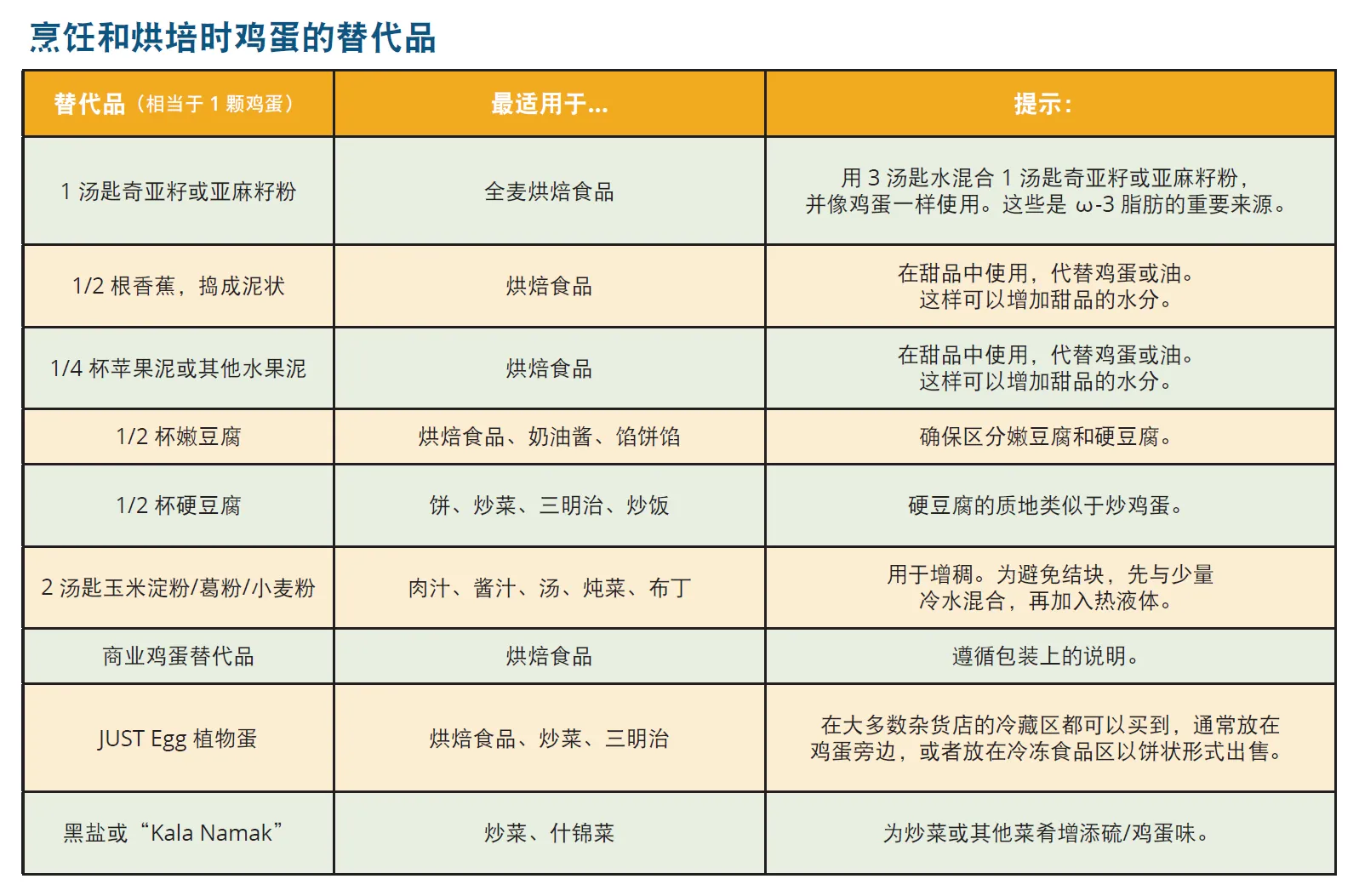
有時,在食譜裡加入雞蛋是因其具有粘合、蓬鬆、增加濕度的效力。然而,也有一些簡單的替代品,例如亞麻籽粉或蘋果泥。豆腐和豆類等食物甚至可以取替雞蛋,製作出美食,如炒豆腐或鷹嘴豆無蛋沙拉。
將雞蛋換成植物性食物不僅可以減少膽固醇、飽和脂肪和動物性蛋白質的攝入,還可以增加纖維、抗氧化劑、維生素、礦物質和植物化學物質的含量。這種改變可以帶來長期的健康益處。
參考資料
1. Li Y, Zhou C, Zhou X, Li L. Egg consumption and risk of cardiovascular diseases and diabetes: a meta-analysis. Atherosclerosis. 2013;229(2):524-530. doi:10.1016/j.atherosclerosis.2013.04.003
2. Spence JD, Jenkins DJ, Davignon J. Dietary cholesterol and egg yolks: not for patients at risk of vascular disease. Can J Cardiol. 2010;26(9):e336-e339. doi:10.1016/s0828-282x(10)70456-6
3. U.S. Department of Agriculture Agricultural Research Service. USDA National Nutrient Database for Standard Reference, Legacy Release. United States Department of Agriculture Agricultural Research Service. Accessed September 24, 2018. https://data.nal.usda.gov/dataset/usda-national-nutrient-databasestandard-reference-legacy-release
4. U.S. Department of Health and Human Services. Your Guide to Lowering Your Cholesterol With TLC. National Institutes of Health. National Heart, Lung and Blood Institute. Accessed September 24, 2018. https://www.nhlbi.nih.gov/files/docs/public/heart/chol_tlc.pdf
5. Clarke R, Frost C, Collins R, Appleby P, Peto R. Dietary lipids and blood cholesterol: quantitative meta-analysis of metabolic ward studies. BMJ. 1997;314(7074):112-117. doi:10.1136/bmj.314.7074.112
6. Howell WH, McNamara DJ, Tosca MA, Smith BT, Gaines JA. Plasma lipid and lipoprotein responses to dietary fat and cholesterol: a meta-analysis. Am J Clin Nutr. 1997;65(6):1747-1764. doi:10.1093/ajcn/65.6.1747
7. Hopkins PN. Effects of dietary cholesterol on serum cholesterol: a meta-analysis and review. Am J Clin Nutr. 1992;55(6):1060-1070. doi:10.1093/ajcn/55.6.1060
8. Levin S, Wells C, Barnard N. Dietary cholesterol and blood cholesterol concentrations. JAMA. 2015;314(19):2083-2084. doi:10.1001/jama.2015.12595
9. Barnard ND, Long MB, Ferguson JM, Flores R, Kahleova H. Industry funding and cholesterol research: a systematic review. Am J Lifestyle Med. 2019;15(2):165-172. doi:10.1177/1559827619892198.
10. Berger S, Raman G, Vishwanathan R, Jacques PF, Johnson EJ. Dietary cholesterol and cardiovascular disease: a systematic review and meta-analysis. Am J Clin Nutr. 2015;102(2):276-294. doi:10.3945/ajcn.114.100305
11. Tang WH, Wang Z, Levison BS, et al. Intestinal microbial metabolism of phosphatidylcholine and cardiovascular risk. N Engl J Med. 2013;368(17):1575-1584. doi:10.1056/NEJMoa1109400
12. Zhao B, Gan L, Graubard BI, Männistö S, Albanes D, Huang J. Associations of dietary cholesterol, serum cholesterol, and egg consumption with overall and cause-specific mortality, and systematic review and updated meta-analysis. Circulation. Published online April 1, 2022. doi:10.1161/CIRCULATIONAHA.121.057642
13. Zhuang P, Wu F, Mao L, et al. Egg and cholesterol consumption and mortality from cardiovascular and different causes in the United States: a population-based cohort study. PLoS Med. 2021;18:e1003508-e1003531. doi:10.1371/journal.pmed.1003508.
14. Ruggiero E, Di Castelnuovo A, Costanzo S, et al. Egg consumption and risk of all cause and cause specific mortality in an Italian adult population. Eur J Nutr. Published online March 24, 2021. doi:10.1007/s00394-021-02536-w
15. Choi Y, Chang Y, Lee JE, et al. Egg consumption and coronary artery calcification in asymptomatic men and women. Atherosclerosis. 2015;241(2):305-312. doi:10.1016/j.atherosclerosis.2015.05.036
16. Li C, Yang L, Zhang D, Jiang W. Systematic review and meta-analysis suggest that dietary cholesterol intake increases risk of breast cancer. Nutr Res. 2016;36(7):627-635. doi:10.1016/j.nutres.2016.04.009
17. Potluri R, Lavu D, Uppal H, Chandran S. Hyperlipidaemia as a risk factor for breast cancer? Report presented at: European Society of Cardiology 2014 Frontiers in Cardiovascular Biology Meeting; July 4, 2014: Barcelona, Spain.
18. Tilley BJ, Cook JL, Docking SI, Gaida JE. Is higher serum cholesterol associated with altered tendon structure or tendon pain? A systematic review. Br J Sports Med. 2015;49(23):1504-1509. doi:10.1136/bjsports-2015-095100
19. Schisterman EF, Mumford SL, Browne RW, Barr DB, Chen Z, Louis GMB. Lipid concentrations and couple fecundity: the LIFE study. J Clin Endocrinol Metab. 2014;99(8):2786-2794. doi:10.1210/jc.2013-3936
20. Zong G, Li Y, Wanders AJ, et al. Intake of individual saturated fatty acids and risk of coronary heart disease in US men and women: two prospective longitudinal cohort studies. BMJ. 2016;355:i5796-i5807. doi:10.1136/bmj.i5796
21. Estadella D, da Penha Oller do Nascimento CM, Oyama LM, Ribeiro EB, Dâmaso AR, de Piano A. Lipotoxicity: effects of dietary saturated and transfatty acids. Mediators Inflamm. 2013;2013:137579-137593. doi:10.1155/2013/137579
22. Schrauwen P. High-fat diet, muscular lipotoxicity and insulin resistance. Proc Nutr Soc. 2007;66(1):33-41. doi:10.1017/S0029665107005277
23. Djoussé L, Khawaja OA, Gaziano JM. Egg consumption and risk of type 2 diabetes: a meta-analysis of prospective studies. Am J Clin Nutr. 2016;103(2):474-480. doi:10.3945/ajcn.115.119933
24. Li Y, Pei H, Zhou C, Lou Y. Dietary cholesterol consumption and incidence of type 2 diabetes mellitus: A dose-response meta-analysis of prospective cohort studies. Nutr Metab Cardiovasc Dis. 2023;33:2-10. doi:10.1016/j.numecd.2022.07.016
25. Djoussé L, Gaziano JM. Egg consumption in relation to cardiovascular disease and mortality: the Physicians’ Health Study. Am J Clin Nutr. 2008;87(4):964-969. doi:10.1093/ajcn/87.4.964
26. Qiu C, Frederick IO, Zhang C, et al. Risk of gestational diabetes mellitus in relation to maternal egg and cholesterol intake. Am J Epidemiol. 2011;173(6):649-658. doi:10.1093/aje/kwq425
27. Keum N, Lee DH, Marchand N, et al. Egg intake and cancers of the breast, ovary and prostate: a dose-response meta-analysis of prospective observational studies. Br J Nutr. 2015;114(7):1099-1107. doi:10.1017/S0007114515002135
28. Tse G, Eslick GD. Egg consumption and risk of GI neoplasms: dose-response meta-analysis and systematic review. Eur J Nutr. 2014;53(7):1581-1590. doi:10.1007/s00394-014-0664-5
29. Miller CA, Corbin KD, da Costa KA, et al. Effect of egg ingestion on trimethylamine-N-oxide production in humans: a randomized, controlled, dose-response study. Am J Clin Nutr. 2014;100(3):778-786. doi:10.3945/ajcn.114.087692
30. Iscovich JM, L’Abbe KA, Castelleto R, et al. Colon cancer in Argentina. I: risk from intake of dietary items. Int J Cancer. 1992;51(6):851-857. doi:10.1002/ijc.2910510603
31. Zhang J, Zhao Z, Berkel HJ. Egg consumption and mortality from colon and rectal cancers: an ecological study. Nutr Cancer. 2003;46(2):158-165. doi:10.1207/S15327914NC4602_08
32. Radosavljević V, Janković S, Marinković J, Dokić M. Diet and bladder cancer: a case-control study. Int Urol Nephrol. 2005;37(2):283-289. doi:10.1007/s11255-004-4710-8
33. Richman EL, Kenfield SA, Stampfer MJ, et al. Egg, red meat, and poultry intake and risk of lethal prostate cancer in the prostate specific antigen-era: incidence and survival. Cancer Prev Res. 2011;4:2110-2121. doi:10.1158/1940-6207.CAPR-11-0354
美國責任醫師營養協會
https://pcrm.widencollective.com/portals/gr0kpkol/factsheets#a1ab59f0-bb29-4ea4-9550-5bfbef4f58dd